

4 mm Pelletized Activated Carbon - VOC & Industrial Air Treatment
4 mm Pelletized Activated Carbon - VOC & Industrial Air Treatment - Trial bag - 27.5lb (12.5kg) is backordered and will ship as soon as it is back in stock.
Couldn't load pickup availability
Bulk pallet & supersack discount - save on 2+ pallets or supersacks. Live freight quotes at checkout.
| Qty | Discount |
|---|---|
| Buy 2 | 5% off each |
| Buy 4 | 10% off each |
Overview
4 mm Pelletized Activated Carbon from Carbon Activated Corporation is a cylindrical activated-carbon adsorption media designed primarily for VOC treatment, compatible solvent-vapor adsorption, odor control and industrial air or process-gas purification.
The pelletized form combines controlled geometry with mechanical strength and favorable airflow characteristics, making 4 mm carbon a common physical form for fixed-bed adsorbers, process-exhaust systems, ventilation treatment and compatible vapor-phase applications.
Compared with irregular granular carbon, uniform pellets can support consistent bed packing and relatively low pressure drop. However, pellet diameter does not determine adsorption capacity by itself. Actual performance depends on the exact carbon grade, pore structure, target contaminant, concentration, temperature, humidity, airflow, bed depth and required outlet concentration.
For broader guidance on activated-carbon forms, pore structure, activity specifications and gas-phase selection, see our Activated Carbon Practical Guide or browse the full Activated Carbon collection .
Product type: 4 mm pelletized activated carbon
Primary phase: Vapor and gas-phase treatment
Primary process configuration: Fixed-bed adsorption
Common uses: VOC treatment, industrial odor control, process-exhaust treatment, solvent-vapor adsorption and compatible air purification
Available packaging: 27.5 lb (12.47 kg) bags and 1,100 lb (approximately 499 kg) supersacks
Primary applications
- Industrial VOC control: Adsorption of compatible volatile organic compounds from manufacturing and process-air streams.
- Process-exhaust treatment: Fixed-bed adsorption of compatible solvent vapors and organic emissions.
- Industrial odor control: Treatment of identified organic odor compounds where standard activated carbon has useful affinity.
- Paint booths & coating operations: Adsorption of selected solvent vapors and compatible organic compounds from exhaust streams.
- Chemical processing: Vapor polishing and adsorption of compatible organic compounds in process gases.
- Wastewater & treatment facilities: Odor and organic-vapor treatment where standard activated carbon is appropriate for the actual contaminant profile.
- Food & industrial processing: Facility-air and process-exhaust odor treatment using an appropriate carbon grade.
- Pilot & validation systems: Small-scale testing before full adsorber loading or permanent media conversion.
Why choose 4 mm pelletized activated carbon?
- Uniform pellet geometry: Cylindrical pellets support consistent packing inside compatible fixed-bed adsorbers.
- Favorable pressure-drop characteristics: Pelletized carbon is commonly selected where airflow resistance is an important system constraint.
- Mechanical durability: Strong pellets can help limit attrition and fines generation during loading and service.
- Vapor-phase system fit: Designed around contact between a contaminated gas stream and a retained activated-carbon bed.
- Fixed-bed compatibility: Suitable for appropriately designed carbon vessels, adsorbers, canisters and air-treatment equipment.
- Scalable packaging: Available for pilot systems, maintenance replacements and larger production adsorbers.
Exact hardness, activity, iodine number, apparent density, ash, moisture, surface area, pore distribution, carbon source and contaminant-specific adsorption capacity depend on the exact supplied grade. Confirm current manufacturer documentation when those properties are required.
4 mm describes physical form - not adsorption performance.
Pellet diameter primarily affects bed packing, airflow and pressure-drop behavior. Two different 4 mm activated carbons can have very different pore structures, activity levels and contaminant affinity.
Select the carbon grade for the contaminant first, then confirm that the pellet geometry fits the adsorber and hydraulic requirements.
Pelletized carbon vs. GAC vs. PAC
| Selection factor | 4 mm Pellets | GAC | PAC |
|---|---|---|---|
| Physical form | Uniform extruded cylinders | Irregular granular particles | Fine powder |
| Typical process phase | Gas / vapor | Primarily liquid; selected gas applications | Liquid |
| How media is used | Retained fixed bed | Retained fixed bed | Dosed directly and later separated |
| Primary physical advantage | Uniform packing and favorable airflow | Flexible particle-size selection | Rapid direct contact and flexible dosage |
| Pressure-drop emphasis | Important design advantage in gas systems | Dependent on mesh size and bed conditions | Not normally used as a retained packed bed |
| Common starting applications | VOC, odor and solvent-vapor treatment | Water and process-liquid purification | Batch purification and decolorization |
For liquid-phase fixed-bed treatment, compare Coconut-Shell GAC and Coal-Based GAC .
What can pelletized activated carbon adsorb?
| Contaminant or objective | General suitability | Important considerations |
|---|---|---|
| Volatile organic compounds (VOCs) | Common primary application | Capacity varies substantially with compound, concentration, temperature, humidity and exact carbon grade |
| Solvent vapors | Common application | Confirm adsorption behavior for the actual solvent mixture and operating conditions |
| Hydrocarbon vapors | Suitable for many compatible compounds | Molecular size, volatility, concentration and competing vapors influence useful capacity |
| Organic odors | Common application when compounds are identified | Determine the odor-causing chemistry rather than selecting media from perceived odor alone |
| Hydrogen sulfide (H₂S) | Highly grade dependent | Impregnated or specialty carbon is often preferred for demanding H₂S service |
| Ammonia | Generally requires specialty media | Standard activated carbon often has limited useful capacity; chemically treated carbon or another adsorbent may be required |
| Acid gases | Highly grade dependent | Impregnated activated carbon or other specialty adsorbents are commonly evaluated |
| Mercury vapor | Specialty application | Use carbon specifically formulated and qualified for mercury treatment |
Important: Standard activated carbon is not a universal gas-phase adsorbent. Identify the target compounds before selecting media, especially for reactive or difficult contaminants such as hydrogen sulfide, ammonia, acid gases and mercury.
Typical product characteristics
| Product type | Pelletized activated carbon |
|---|---|
| Pellet diameter | 4 mm |
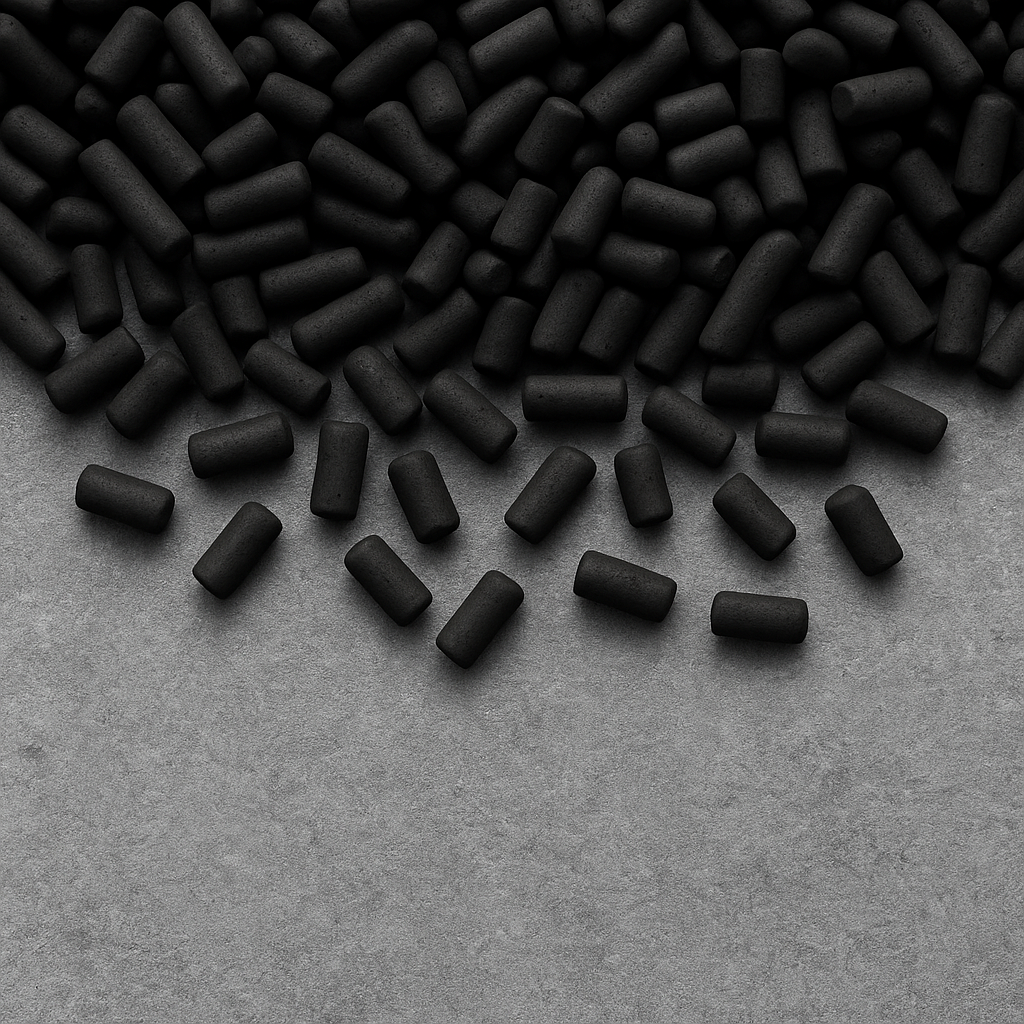
| Physical form | Black cylindrical pellets |
| Primary phase | Vapor and gas-phase treatment |
| Primary process mode | Retained fixed-bed adsorption |
| Common treatment functions | Selected VOC adsorption, solvent-vapor treatment, organic-odor control, hydrocarbon-vapor adsorption and compatible industrial air purification |
| Supplier | Carbon Activated Corporation |
| Available packaging | 27.5 lb bags and 1,100 lb supersacks |
Technical-data note: Grade-specific activity, iodine number, hardness, ash, moisture, apparent density, surface area, pore volume, carbon source and contaminant-specific adsorption data should be confirmed for the exact supplied grade before final qualification or adsorber design.
Vapor-phase system design considerations
Activated-carbon performance in an air-treatment system depends on both the carbon grade and the adsorber. Total media weight or pellet diameter alone does not determine removal efficiency or service life.
| Design factor | Why it matters |
|---|---|
| Target contaminant | Different VOCs and gases have different adsorption affinities and may require different carbon chemistries |
| Inlet concentration | Higher contaminant loading generally consumes available adsorption capacity more quickly |
| Airflow | Influences superficial velocity, residence time, pressure drop and contaminant loading rate |
| Bed depth | Provides the media inventory and depth required for an effective mass-transfer zone |
| Gas-phase contact time | The gas stream must remain in contact with the carbon long enough for useful mass transfer to occur |
| Relative humidity | Water vapor can compete for pore access and reduce useful capacity for some target compounds |
| Temperature | Higher temperature generally reduces physical adsorption capacity for many VOCs |
| Pressure drop | Must remain compatible with available fan or blower capacity |
| Competing vapors | Multi-component streams can consume carbon capacity differently than a single-contaminant system |
For preliminary carbon selection, provide the target contaminant, inlet concentration, airflow, temperature, relative humidity, vessel dimensions and required outlet concentration through our contact page.
For additional background on pore structure, vapor-phase activity and activated-carbon selection, see the Activated Carbon Practical Guide .
Low pressure drop is valuable - but it is not the treatment objective.
A carbon bed that moves air efficiently can still perform poorly if the carbon has weak affinity for the contaminant, the bed is too shallow, the gas is too hot or humid, or residence time is inadequate. Hydraulic fit and adsorption performance must both be considered.
Service life & breakthrough
There is no universal replacement interval for pelletized activated carbon. Service life depends on contaminant loading, grade-specific adsorption capacity, airflow, bed depth, temperature, humidity, competing compounds, operating schedule and the required outlet concentration.
- Establish a measurable outlet or breakthrough criterion for the application.
- Monitor downstream contaminant concentration where control is critical.
- Track operating hours and estimated contaminant loading where practical.
- Monitor system differential pressure for abnormal changes.
- Replace or evaluate carbon as breakthrough approaches the established treatment limit.
- Do not rely on human odor detection as the only indication of media condition.
For regulated-emission, industrial-hygiene or safety-critical applications, monitoring and replacement criteria should be established according to the applicable process, environmental and engineering requirements.
Standard vs. impregnated activated carbon
Standard pelletized activated carbon primarily relies on physical adsorption and is commonly evaluated for compatible VOCs, solvent vapors, hydrocarbons and organic odor compounds.
More difficult or reactive gases may require chemically treated or impregnated carbon designed specifically for the contaminant.
| Media type | Common starting role | Important limitation |
|---|---|---|
| Standard activated carbon | Compatible VOCs, solvent vapors, hydrocarbons and organic odors | May provide limited useful capacity for reactive or poorly adsorbed gases |
| Impregnated carbon | Contaminants requiring added chemical reactivity or enhanced capture | Impregnation chemistry must match the contaminant and operating conditions |
| Layered / staged media | Streams containing multiple contaminant classes | Media sequence, chemical compatibility and total pressure drop must be engineered appropriately |
If your application involves H₂S, ammonia, mercury, acid gases or a mixed contaminant stream, identify the target compounds and concentrations before ordering so an appropriate specialty carbon or complementary adsorbent can be evaluated.
Packaging & availability
| Package size | Typical use |
|---|---|
| 27.5 lb (12.47 kg) bag | Small adsorbers, maintenance replacements, pilot systems and incremental media loading |
| 1,100 lb (approximately 499 kg) supersack | Production adsorbers, larger bed changeouts, recurring industrial requirements and compatible bulk handling systems |
- Bag orders: Suitable for smaller systems and manual adsorber loading
- Supersack orders: Suitable for larger adsorbers and production-scale carbon requirements
- Freight: Parcel, pallet or LTL service based on package size, quantity and destination
- Lead time: Confirmed at quotation or order placement
- Volume purchasing: Contact Sorbents Direct for pallet quantities, recurring requirements or delivered bulk pricing
Installation & handling considerations
- Inspect the adsorber, support screens, retainers, seals and airflow components before loading.
- Confirm that vessel internals are compatible with 4 mm pelletized media.
- Load carbon carefully to minimize pellet breakage and fines generation.
- Distribute media evenly to reduce channeling, bypass and uneven bed depth.
- Protect the carbon from oils, chemicals, liquid water, dust and foreign contamination during loading.
- Store unused carbon in a clean, dry location with packaging closed until use.
- Use suitable ventilation and personal protective equipment as specified by the current SDS.
- Handle spent carbon according to the substances it has adsorbed and applicable environmental requirements.
Important: The hazards and waste classification of spent activated carbon depend on the contaminants it has adsorbed. Establish appropriate procedures for removal, storage, transportation, reactivation or disposal based on the actual spent media.
Why buy from Sorbents Direct?
Vapor-phase activated-carbon selection involves more than choosing a pellet diameter. Sorbents Direct helps industrial buyers evaluate contaminant chemistry, carbon type, bed requirements, packaging, freight and technical documentation before purchase.
- Transparent online pricing on qualifying package sizes and variants
- Small and bulk formats for pilot systems, maintenance and production adsorbers
- Live freight quotes at checkout for eligible shipments
- Manufacturer-document support including SDS, TDS and COA when available
- Technical selection support based on contaminant, airflow, concentration, humidity and system requirements
- Specialty-carbon sourcing where impregnated or application-specific carbon is required
- Bulk purchasing assistance for recurring industrial requirements
Need a different activated-carbon form?
Browse the Activated Carbon collection for pelletized carbon, coconut-shell GAC, coal-based GAC and powdered activated carbon.
For larger recurring requirements, see Bulk Industrial Adsorbents & Filtration Media Supplier .
Documentation & quality support
Available documentation may include:
- Safety Data Sheet (SDS)
- Technical Data Sheet (TDS)
- Certificate of Analysis for the supplied lot, when available
- Pellet-size and packaging information
- Grade-specific physical properties and activity data where available
- Contaminant-specific adsorption information where available
- Freight and handling information
Technical properties and contaminant-specific performance should not be assumed from the 4 mm pellet designation alone. Request current documentation for the exact supplied grade when carbon source, activity, hardness, density, pore structure or contaminant capacity is important to the application.
Visit our Documentation Center or contact Sorbents Direct to request documentation or discuss your air-treatment application.
Questions & answers
What is 4 mm pelletized activated carbon used for?
4 mm pelletized activated carbon is commonly used in compatible vapor-phase systems for VOC adsorption, solvent-vapor treatment, industrial odor control, hydrocarbon-vapor adsorption and process-exhaust purification.
What does 4 mm mean?
The 4 mm designation refers primarily to the approximate pellet diameter. It describes the physical form of the media and does not by itself specify adsorption capacity, pore structure, activity or contaminant suitability.
Is pelletized activated carbon intended for water or air treatment?
This product is primarily positioned for air, vapor and gas-phase treatment. Granular activated carbon is generally the more common physical form for conventional fixed-bed water treatment.
Why use pellets instead of granular activated carbon?
Uniform pellets can provide consistent bed packing, good mechanical durability and favorable pressure-drop characteristics in gas-phase fixed beds. The actual carbon chemistry must still be appropriate for the target contaminant.
Does 4 mm activated carbon remove VOCs?
Pelletized activated carbon is widely used for many compatible VOCs, but actual capacity depends on the exact compound, carbon grade, concentration, temperature, humidity, airflow and contact conditions.
Does lower pressure drop mean better adsorption?
No. Lower pressure drop improves hydraulic or airflow performance but does not indicate greater contaminant capacity. Adsorption performance depends on carbon chemistry, pore structure, bed depth, residence time and the target contaminant.
Will standard pelletized carbon remove hydrogen sulfide?
Standard activated carbon may have limited useful capacity for hydrogen sulfide. Impregnated or specialty carbon is often preferred for demanding H₂S treatment. Confirm concentration and operating conditions before selecting media.
Can pelletized carbon remove ammonia or acid gases?
These compounds often require impregnated activated carbon or another specialty adsorbent rather than standard activated carbon. Media should be selected around the exact contaminant chemistry.
How long does pelletized activated carbon last?
There is no fixed service interval. Bed life depends on contaminant concentration, grade-specific capacity, airflow, bed depth, temperature, humidity, competing vapors and the required outlet concentration. Breakthrough monitoring provides the most useful replacement basis.
Can pelletized carbon be used in layered media beds?
Yes, when the adsorber is designed appropriately. Staged media can address multiple contaminant classes, but media sequence, chemical compatibility, airflow and total pressure drop should all be evaluated.
What information is needed to evaluate an activated-carbon air-treatment system?
Useful information includes target contaminants, inlet concentrations, required outlet levels, airflow, temperature, relative humidity, vessel dimensions, available bed depth, operating schedule and allowable pressure drop.
What package sizes are available?
The currently listed formats are 27.5 lb bags and 1,100 lb supersacks. Contact Sorbents Direct for recurring requirements, pallet quantities or larger commercial purchasing.
Related products & resources
- Browse all activated carbon products
- Activated Carbon Practical Guide for Industrial Purification
- View coconut-shell granular activated carbon
- View coal-based granular activated carbon
- Bulk industrial adsorbents & filtration media supply
- Request SDS, TDS or COA documentation
- Request vapor-treatment assistance or a volume quote

4 mm Pelletized Activated Carbon - VOC & Industrial Air Treatment


